
Table of Contents
Let’s not sugarcoat it — becoming a sweepstakes game distributor isn’t some shiny “set it and forget it” hustle. It’s closer to building a small power grid. You’re wiring together software providers, retail locations, compliance rules, payments, and player demand. When it’s wired right, the lights stay on and the revenue hums. When it’s sloppy, things short-circuit fast.
This guide walks you through the real path — the moving parts, the legal edges, the money mechanics, and the operator mindset you actually need.
What a Sweepstakes Game Distributor Actually Does (Day-to-Day Reality)
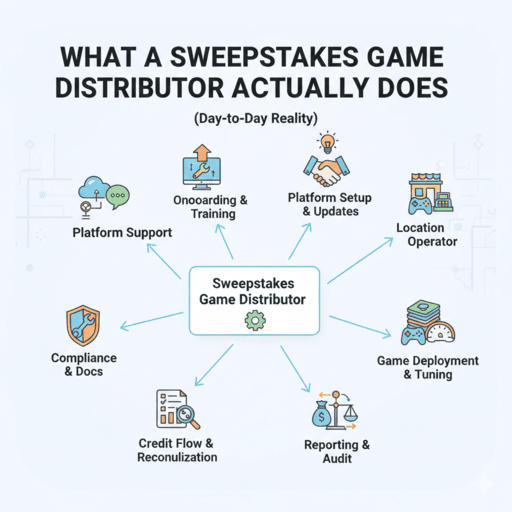
A distributor sits between the platform and the location operator. You’re not just “selling games.” You’re enabling a system.
You typically handle:
- Merchant onboarding and training
- Platform setup, configuration, and updates
- Game library deployment and performance tuning
- Credit flow structure and reconciliation
- Reporting pipelines and audit logs
- Compliance alignment and documentation
- Ongoing technical support and issue resolution
Think of it less like product sales and more like infrastructure distribution. If the platform is the engine, you’re the road network.
Sweepstakes Distribution vs Gambling Operations — Know the Line First
Before anything else, understand the legal separation. This is not optional reading.
Sweepstakes models are commonly structured around promotional entry mechanics — typically using a “no purchase necessary” concept and an alternate method of entry. If you want a plain-language refresher, start with your own internal compliance page on no purchase necessary requirements and then zoom out to regulator-facing material like FinCEN’s MSB registration overview.
Why mention FinCEN at all? Because payment flow + stored value + “who handles what” can put distributors and operators into conversations about money services, recordkeeping, and compliance expectations. You don’t want to find that out after you scale.
For the “don’t be shady in marketing” side of sweepstakes, the FTC’s consumer guidance and enforcement posts around lotteries and sweepstakes are worth skimming — it’s a quick way to understand what regulators tend to hate.
And if you want a structured internal framework to keep your house clean, lean on your own legal guide, federal law overview, and state laws reference while you build your distribution SOPs.
Who This Business Fits Best
This field attracts a specific kind of operator:
- Entrepreneurial network builders who enjoy territory growth
- Retail/cafe operators who understand foot traffic and repeat customers
- Tech-comfortable resellers who can handle dashboards and devices
- Compliance-aware operators who don’t treat rules like “optional vibes”
The Real Skills That Matter More Than Credentials
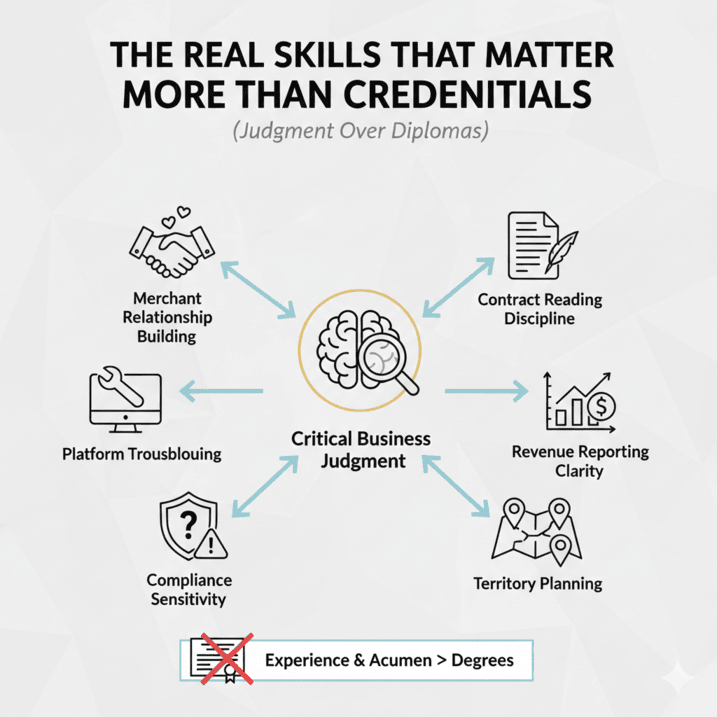
Nobody asks for your degree in this business. They watch your judgment.
What matters:
- Merchant relationship building (trust closes deals)
- Platform troubleshooting comfort (you don’t need to code, but you can’t freeze)
- Compliance sensitivity (you smell risk early)
- Contract reading discipline (you don’t sign “hope”)
- Revenue reporting clarity (numbers don’t lie, but people do)
- Territory planning (you build density, not chaos)
If you panic when systems misbehave — wrong lane. These systems always misbehave at some point.
Types of Sweepstakes Game Platforms You Can Distribute
Not every platform fits every market. Distribution success is platform-location fit.
Common categories:
- Multi-game sweepstakes systems
- Cafe terminal networks
- Mobile-first sweepstakes ecosystems
- Vertical screen / kiosk setups
- Distributor-controlled libraries (where you manage configs and rotations)
If you’re building around well-known game ecosystems, your site already has distributor pathways for specific products. Examples you can reference internally when building merchant education pages include Fire Kirin distributors and agents, Orion Star distributors and agents, Panda Master distributors and agents, and Golden Dragon distributors and agents.
The goal isn’t to “carry everything.” It’s to carry what your merchant base can actually operate cleanly.
How Distributor Revenue Actually Works
Three common models dominate:
Revenue Share Model
You earn a percentage split based on location volume.
Best for:
- Long-term scaling
- Strong merchant training
- Locations with consistent traffic
Platform Licensing Spread
You earn margin between your platform cost and merchant subscription.
Best for:
- Predictable billing
- Smaller merchant pools
- Lower operational complexity
Hybrid Structure
Base fee + performance share.
Often the healthiest model because it covers support costs while keeping upside.
Step-By-Step: How to Become a Sweepstakes Distributor (The Real Ladder)
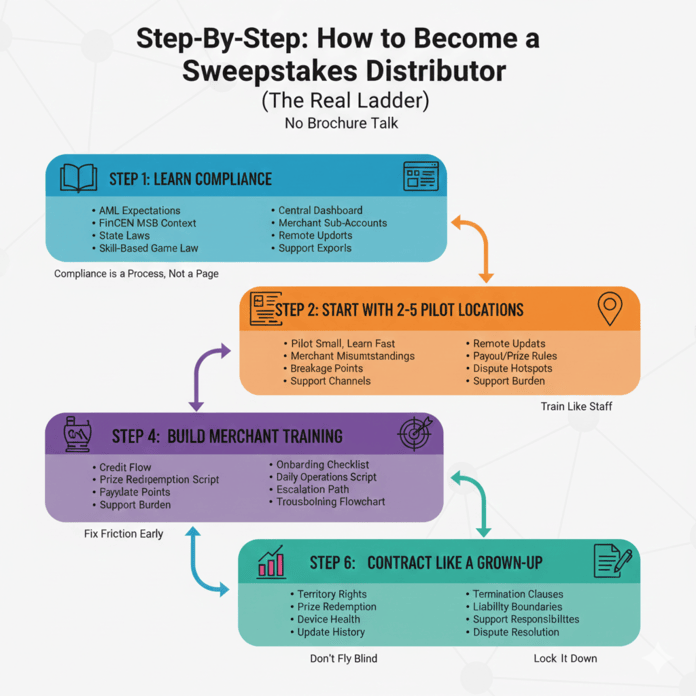
Step 1 — Learn Compliance Before You Touch a Platform 📚
Start with compliance fundamentals and repeat them until they’re boring.
Build your distributor knowledge base around:
- anti-money laundering expectations (process and controls)
- FinCEN MSB context (how regulators frame MSBs)
- state-by-state legal considerations (jurisdiction changes everything)
- your internal skill-based gaming law and regulation explainer (for classification conversations)
If you want an operator’s rule of thumb: compliance is not a page — it’s a process.
Step 2 — Choose a Provider With Distributor Controls (Not Just “Pretty Games”)
You want:
- Central dashboard
- Merchant sub-accounts
- Remote updates and configuration
- Reporting exports (clean logs)
- Role-based access controls
- Support channels that actually respond
If the provider can’t show you robust reporting, you’re basically driving at night with your headlights off.
Step 3 — Start With 2–5 Pilot Locations Only (Yes, Only)
Not 20. Not 50.
Pilot small. Learn fast. Fix friction early.
What pilots teach you:
- what merchants misunderstand
- what breaks under real usage
- where disputes pop up
- how often you’ll get “urgent” calls
- what your support burden really looks like
Step 4 — Build Merchant Training Like You’re Training Staff, Not “Customers” 🎯
Untrained merchants cause:
- payout confusion
- reporting gaps
- compliance mistakes
- player disputes
- reputation damage
Your “merchant kit” should include:
- onboarding checklist
- daily operations script
- payout and prize rules clarity
- escalation path (who calls who)
- basic troubleshooting flowchart
You can even reference your internal service capabilities like game customization and game development to show merchants you’re not a fly-by-night middleman.
Step 5 — Install Reporting Discipline From Day One (Or Pay Later)
Track:
- credit flow
- prize redemption events
- merchant share vs distributor share
- suspicious patterns and anomalies
- device health checks
- update and configuration history
For tax-related reporting awareness (especially around prizes and awards), it’s smart to understand how the IRS frames prize reporting in general via About Form 1099-MISC and the 1099 instructions. You’re not becoming an accountant — you’re becoming harder to surprise.
Step 6 — Contract Like a Grown-Up (Not Like a Hopeful Beginner)
Key contract items distributors should lock down:
- territory rights
- termination clauses
- liability boundaries
- support responsibilities
- merchant default handling
- dispute resolution
- reporting access and data ownership
If the agreement is vague, it’s not “flexible.” It’s a trap.
The Technology Stack You’ll Eventually Need (Keep It Simple, Keep It Tight)
Minimum viable stack:
- Distributor dashboard / admin panel
- Remote configuration and update tool
- Transaction logging + export capability
- Merchant account controls
- Role-based permissions
- Device monitoring and uptime alerts
If you want a solid baseline for cybersecurity thinking (especially once you manage multiple locations), NIST provides small-business friendly material under NIST cybersecurity framework resources. Not because you want to be paranoid — because you want to be professional.
A Quick “Distributor Readiness” Checklist
| Area | If you can’t answer this clearly… |
|---|---|
| Compliance | You’re not ready to scale |
| Reporting | You’ll lose money in disputes |
| Support | Merchants will churn |
| Contracts | You’ll get squeezed |
| Territory | You’ll grow chaos, not revenue |
Common Distributor Mistakes (Seen Too Often)
New distributors mess up when they:
- chase platforms without reading compliance basics
- skip merchant training
- overpromise earnings to close deals
- expand too fast
- ignore reporting until “later”
- rely on verbal agreements
- treat support like a side task
Fast growth without control is just delayed collapse.
Scaling Strategy That Actually Works (Boring… Until It Wins)
Scaling isn’t “more locations.” Scaling is repeatable systems.
Build:
- onboarding templates
- training scripts
- support workflows
- reporting SOPs
- territory segmentation
- compliance checklists
Then scale.
Not before.
If you’re actively recruiting and want a clean conversion pathway, your own agents and distributors wanted page can function as a funnel — but only if your onboarding and support are real.
The Street Truth Most Guides Won’t Tell You
This business is less about games and more about operator discipline.
The winners aren’t the loudest sellers.
They’re the calmest system builders.
They document everything.
They train merchants.
They audit numbers.
They read contracts twice.
They scale slowly — then suddenly.
Like laying railroad tracks — boring up close, powerful at scale
FAQs
No. Jurisdiction matters. Laws vary by state and locality, and enforcement posture can differ widely. Start by reviewing state-level rules and keep a working understanding of the federal compliance landscape.
Helpful references: FinCEN (U.S. financial compliance & AML oversight) and Gambling industry regulatory news & enforcement coverage.
No—but you do need platform fluency. You should be comfortable navigating dashboards, reviewing logs, pushing remote updates, and coordinating with support. Without operational comfort in the platform, routine issues can quickly overwhelm you.
Usually 2–5 pilot locations. Early rollout is about testing your process, reporting discipline, and merchant support model—not scaling ego-first.
Merchant quality. Strong, compliant, well-managed locations can make even an average platform profitable. Poor merchants can sink performance even with top-tier software.
Clean reporting, strong training, and disciplined compliance. Keep your internal legal guide and anti-money-laundering framework active and operational—not just documented.
Compliance baseline reference: FinCEN AML guidance library.