
Table of Contents
Both platforms look similar from the outside. Live with either one for a few months, and the differences start to feel much less subtle — especially once your distribution grows.
Why This Comparison Is Worth Taking Seriously in 2026

Most agents picking between Juwa and Game Vault spend the first week comparing screenshots. They evaluate the interface, browse through available titles, maybe run a quick demo — and that’s about it. Honestly, that approach misses the point almost entirely.
The parts that actually determine whether a platform is worth your time rarely show up in the first impression. Credit allocation speed during high-traffic hours. Dashboard behavior when you’re managing six different player groups simultaneously. How the backend handles a promotional rollout without things getting patchy. Those details don’t make it into marketing materials, but experienced sweepstakes distributors will tell you — they’re the whole game.
What’s actually shifted heading into 2026 is that agents are starting to think about platform selection the same way a business owner thinks about choosing payment infrastructure. Everything seems fine at low volume. Then you scale, and suddenly small inefficiencies turn into real operational friction. That’s exactly the moment when people start regretting hasty platform decisions.
If you’re still early in the research stage, the top sweepstakes platforms guide for 2026 gives a broader view of what serious operators are gravitating toward useful context before narrowing it down to these two.
The Dual Currency Model — What It Actually Means
Both platforms run on a dual currency sweepstakes structure. One currency handles entertainment gameplay. The second connects to promotional prize eligibility. It’s a structure that lets operators work within promotional frameworks rather than traditional wagering environments — and that distinction matters quite a bit legally.
Think of it less like a casino backend and more like running a loyalty ecosystem. Agents distribute credits, track engagement patterns, and pace promotional rewards. The FTC’s promotional guidelines offer useful framing here — the goal isn’t just running games, it’s designing campaigns that hold up under scrutiny.
“Managing a dual currency gaming platform well is less about technical setup and more about understanding how players respond to promotional pacing over time.”
One genuinely underappreciated advantage of this model is its flexibility. Seasonal promotions, retention bonuses, structured reward windows — you can introduce all of that without touching the underlying platform architecture. It’s why agents who first learned the model often describe a moment where everything clicked: they weren’t managing a gaming system, they were managing player behavior.
Juwa: What Distributors Actually Experience

Juwa has developed a reputation for something that sounds simple but is genuinely hard to pull off: it doesn’t feel overwhelming at first, but it doesn’t insult your intelligence once you know what you’re doing either.
New agents tend to find the onboarding relatively forgiving. The Juwa distributors and agents setup is deliberately structured to reduce friction in the early stages — which is useful when you’re still learning how different player types interact with the system. There’s a lot going on under the hood, but the platform doesn’t make you feel like you need to understand all of it on day one.
The game library is genuinely varied — fish tables, slot-style titles, hybrid arcade formats. That breadth is worth something. Not every player who walks through the door is looking for the same thing, and when a platform can serve multiple engagement styles, session duration tends to benefit quietly. Players stay longer when they can change gears.
What surprises a lot of agents is discovering the configuration depth once they move past the basic setup. Juwa distributes settings across layered panels rather than surface-level menus. It can feel slightly complex early on — but that layered structure is actually intentional. It’s what makes Juwa scale reasonably well when you start managing multiple player groups and need granular control over each one.
Game Vault: Where It Quietly Outperforms
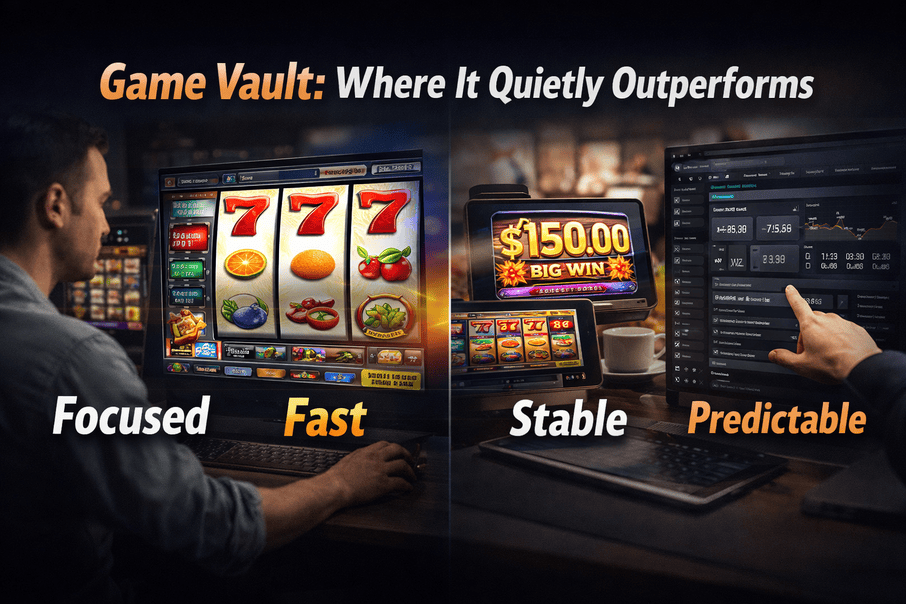
Game Vault doesn’t try to win on variety. That’s almost its entire personality as a platform — focused, fast, and predictable in the best possible sense.
The slot-focused environment means players know what they’re getting. The interaction loop is quick, the visual feedback is consistent, and the experience doesn’t ask too much from users before they’re engaged. Agents exploring the Game Vault distributors and agents system often highlight this as an underrated quality — when gameplay is that streamlined, promotional planning gets simpler too.
The thing that doesn’t get mentioned often enough about Game Vault is stability. Loading performance stays consistent even when session activity spikes. The interface doesn’t behave differently across device types. None of that sounds exciting written down, but ask anyone who’s managed a busy player group through a promotional weekend — stable infrastructure is quietly everything.
Where Game Vault does face honest limitations is depth. Agents who want to serve mixed demographics — players who rotate between fish games, arcade-style formats, and slots — will find the narrower library creates ceiling relatively fast. That’s not necessarily a dealbreaker. It just shapes what kind of operation fits the platform.
Side-by-Side Feature Comparison
| Feature | Juwa | Game Vault |
|---|---|---|
| Game Variety | Slots, fish tables, arcade hybrids | Primarily slot-focused |
| Learning Curve | Gradual — gets deeper over time | Straightforward from day one |
| Player Retention | Variety-driven engagement | Consistent loop pacing |
| Backend Controls | Layered, flexible configuration | Simplified, centralized menus |
| Mobile Stability | Strong | Very stable |
| Scalability Comfort | Multi-group ready | Comfortable at moderate scale |
| Demographic Reach | Broader appeal | Consistent, narrower focus |
Reading a table like that cold, the differences look manageable. The honest caveat is that tables flatten nuance. Neither platform is dramatically better in absolute terms — but one will fit your operational style better than the other, and that fit becomes increasingly important as your setup grows.
Backend Control and Day-to-Day Operations
The backend is where most platform comparisons run out of patience — which is a shame, because that’s where the actual experience lives once the initial setup excitement wears off.
Juwa distributes its configuration settings across multiple panels. It’s initially layered in a way that can feel like you’re hunting for things. But once you know where everything lives, that structure gives you meaningful granularity — particularly useful when running different promotional pacing across distinct player segments. Agents who’ve gone through formal sweepstakes agent registration tend to appreciate this kind of structural control more once they understand what compliance oversight actually requires at scale.
Game Vault centralizes its common adjustments into simplified menus. The tradeoff is less customization, but faster access to what you actually use most. For agents who aren’t running complex multi-tier promotions, this feels like a relief rather than a limitation.
A useful analogy: it’s like comparing two different website builders. One gives you more control over every element. The other gets you live faster and keeps you from breaking things accidentally. Neither is wrong. The right choice depends on how much configuration you actually need.
Player Retention — Where the Real Difference Lives
Retention is one of those topics everyone nods at and then underinvests in until they see churn numbers that are hard to ignore. Both platforms support retention in different ways — and understanding that difference before you commit to one is worth the time.
Juwa’s varied content library creates natural exploration incentives. Players who get tired of one format can shift to another without leaving the platform. That behavioral flexibility often translates into longer session activity — not because any single game is more compelling, but because the overall environment feels less exhaustible.
Game Vault’s faster loop structure does something different. It reinforces repetition rather than exploration. Players who enjoy a predictable engagement rhythm tend to stay highly active within that structure. The challenge is that once the novelty of the format wears off for any individual player, there’s limited new territory to discover within the platform.
Some agents introduce staggered reward pacing — spacing promotional payouts to create ongoing momentum rather than front-loading incentives. Others keep promotional structures simple and let the platform carry engagement naturally. Neither is a universal answer. The key is matching your promotional strategy to how the platform actually shapes player behavior, which varies significantly between these two.
Compliance Awareness Every Agent Should Have

This section isn’t the most exciting part of a platform comparison — but skipping it entirely is something operators tend to regret later.
Sweepstakes systems operate outside traditional wagering frameworks, but that doesn’t mean compliance is a non-issue. Understanding FinCEN MSB guidance is relevant for any operator handling digital credit transactions at volume. The question of whether sweepstakes operators need an MSB license is one that catches people off guard — it’s worth reading before assuming the answer is obviously no.
The anti-money laundering framework for sweepstakes game rooms is another area that’s evolved significantly in recent years. Transaction monitoring signals, identity verification triggers, structured promotional mechanics — these aren’t things you implement after a problem surfaces. The FinCEN official guidance portal is worth bookmarking for ongoing reference.
For state-specific context, the legal guide and state-by-state laws overview on Elite Entertainment’s site cover most of the major regulatory environments agents work within.
Which Platform Holds Up When You Start Scaling
Scalability is one of those qualities that’s genuinely hard to evaluate before you actually need it. Both platforms work at small volumes. The differences become apparent once you’re managing multiple player groups, running overlapping promotional cycles, and handling support requests simultaneously.
Juwa’s layered configuration structure is — somewhat counterintuitively — better suited to expansion. More panels means more places to manage things independently. When you’re running separate promotional pacing for different groups, that separation becomes operationally useful rather than just organizationally tidy.
Game Vault’s simplified structure starts to feel its constraints more noticeably at higher scale. That’s not a flaw exactly — it’s a reflection of the platform’s design priorities. Agents who want to expand gradually and keep operations lean often find Game Vault comfortable well into moderate growth. It’s agents building toward high-volume multi-location distribution who tend to hit its ceiling first.
If you’re actively building toward a larger operation, exploring the agents and distributors program early gives you useful context about what that trajectory actually looks like from an infrastructure standpoint.