
Table of Contents
The Real Question Most Distributors Are Afraid to Ask
Let’s not pretend this is just another “comparison article.” It isn’t.
If you’re reading this, you’re probably already knee-deep in the sweepstakes space—or at least circling it. Maybe you’ve talked to a few agents, maybe you’ve tested one platform, maybe you’ve even lost money picking the wrong system. It happens more than people admit.
The debate around Orion Star vs Fire Kirin isn’t about which app looks better or which one has more flashy fish tables. It’s about something way more practical—which one actually holds up when real money, real players, and real pressure come into play.
Both platforms operate inside the broader dual currency sweepstakes model, which—if you’ve already been around—means you’re dealing with virtual credits, redemption systems, and a whole layer of compliance that most newcomers completely underestimate. If you haven’t already brushed up on how this works, it’s worth reviewing the basics through this legal guide because one wrong assumption here can cost you everything.
Now, here’s where things start to split.
Some distributors lean toward Orion Star because it feels scalable and predictable. Others swear by Fire Kirin because of the control it gives them behind the scenes. And honestly? Both camps think they’re right.
So instead of pushing one answer, let’s break it down the way an actual operator would—looking at retention, margins, backend control, and what happens when things don’t go as planned.
Understanding How These Platforms Actually Make You Money

Before comparing features, you need to understand the engine behind both systems.
At the distributor level, your income isn’t coming from the platform—it’s coming from how you manage credit distribution, player behavior, and redemption flow. That’s it. Everything else is secondary.
Both Orion Star and Fire Kirin rely on a credit-based gaming system, where players purchase credits (or receive them through promotional models) and then engage with games that simulate casino-style mechanics. But what matters is how that system behaves under pressure.
For example, if players churn quickly, your margins collapse. If redemption patterns spike unpredictably, your cash flow gets messy. If you don’t understand your backend, you’re basically flying blind.
This is where concepts like player lifetime value (LTV) and backend credit management systems stop being “technical jargon” and start becoming survival tools.
Interestingly, many new operators skip this part entirely. They focus on onboarding players but ignore retention mechanics, which is exactly why so many fail within the first few months. If you want a deeper breakdown of how distributors actually structure their business, this step-by-step distributor guide lays it out pretty clearly.
Orion Star: Built for Scale, But Not Without Tradeoffs
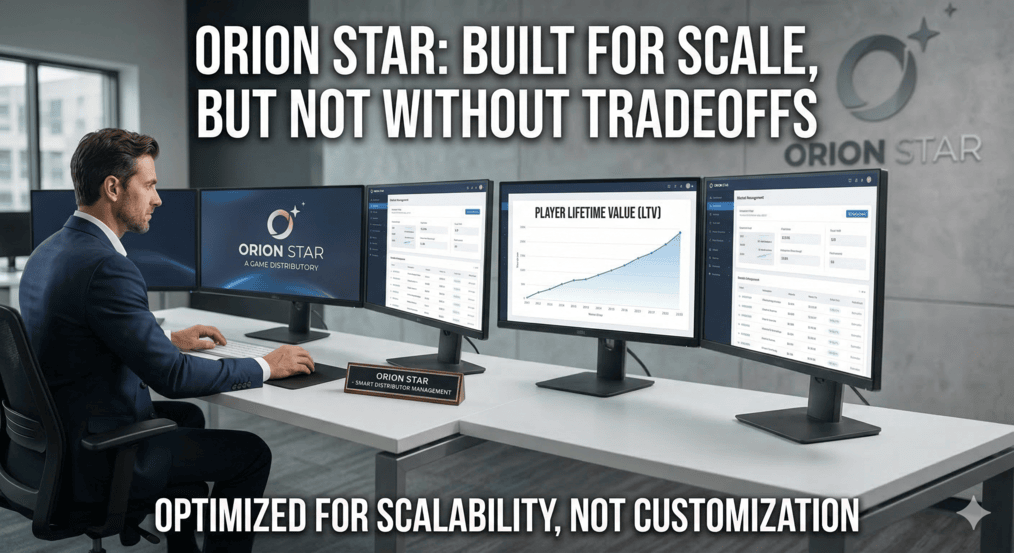
Orion Star feels… polished. That’s usually the first impression.
The interface is smoother, the game selection is broader, and the onboarding process doesn’t feel like you’re hacking your way through a system built in 2012. From a player’s perspective, it’s easy to get into—and that matters more than most distributors realize.
What really sets Orion Star apart is its game variety. You’re not just dealing with fish tables; you’re working with a mix of slot-style games, hybrid systems, and evolving content that keeps players engaged longer. That directly impacts retention, which—again—is where your real profit lives.
But here’s the catch.
Because Orion Star is more structured, you don’t get as much freedom in how you manage pricing or backend controls. It’s optimized for scalability, not customization. That’s great if you’re building a network, but it can feel restrictive if you’re trying to fine-tune margins at a granular level.
If you want to explore how Orion Star fits into a broader distributor ecosystem, you can look at this Orion Star distributors and agents page, which outlines how agents typically structure their operations.
Fire Kirin: More Control, More Responsibility
Fire Kirin is different. Not better or worse—just different.
Where Orion Star focuses on scale, Fire Kirin leans heavily into control. You get more flexibility with pricing, more visibility into your backend, and more ability to adjust how your system behaves.
For experienced operators, that’s a big deal.
You can tweak margins, adjust credit flow, and essentially shape your business model in ways Orion Star doesn’t allow. But—and this is important—that control comes with responsibility.
If you don’t know what you’re doing, Fire Kirin can expose your weaknesses fast.
The platform is heavily centered around arcade-style sweepstakes games, especially fish tables. That creates a very specific type of player base—one that’s highly engaged but sometimes less diverse in behavior. If your audience matches that niche, you can do really well. If not, growth can stall.
To understand how Fire Kirin operates at the distributor level, take a look at this Fire Kirin distributors and agents page
Side-by-Side Comparison: What Actually Matters
| Feature | Orion Star | Fire Kirin |
|---|---|---|
| Game Variety | Broad (slots + fish + hybrid) | Focused (fish + arcade) |
| Player Retention | Higher (diverse gameplay) | Strong but niche |
| Backend Control | Moderate | High |
| Scalability | Excellent | Moderate |
| Ease of Use | Beginner-friendly | Requires experience |
| Profit Flexibility | Stable | Adjustable |
Compliance Isn’t Optional Anymore (And This Changes Everything)
Here’s something a lot of distributors overlook until it’s too late.
The sweepstakes industry is under increasing scrutiny, especially around AML (anti-money laundering) and financial behavior patterns. It’s not just about running games anymore—it’s about how money flows through your system.
If your operation starts resembling a financial service—moving value, holding balances, enabling rapid redemptions—you may fall into categories that require additional oversight. That’s where things like MSB (Money Services Business) classification come into play.
If this sounds confusing, you’re not alone. This MSB licensing breakdown explains when and why these rules apply.
Both Orion Star and Fire Kirin operate in this space, but how you use them determines your risk level. And trust me—this is one area you don’t want to “figure out later.”
So… Which One Should You Actually Choose?
Here’s the honest answer, without fluff.
If you’re:
- Building a scalable network
- Want predictability
- Prefer simpler management
👉 Orion Star is probably the better fit.
If you’re:
- Experienced
- Want full control over margins
- Comfortable managing backend systems
👉 Fire Kirin might give you an edge.
But here’s the thing most people won’t say out loud…
The platform itself doesn’t make you successful. Your ability to manage players, control credit flow, and adapt to changes—that’s what decides whether you win or lose in this space.